en
en Call us
 Contact us
 For renters


Culture
The church of Our Lady of Mount Carmel
Church of Our Lady of Mount Carmel in Brela: A Monument to victory and a masterpiece of builders
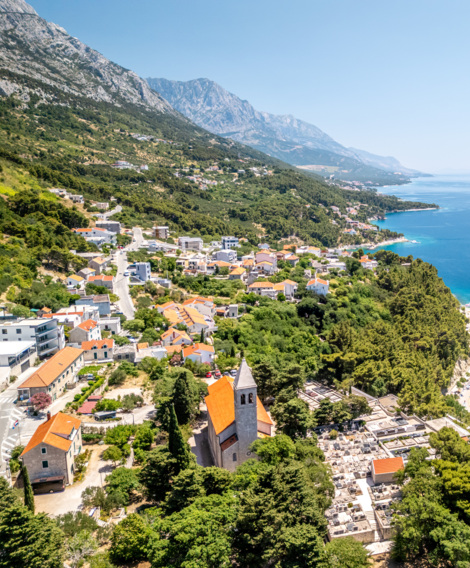
The church of Our Lady of Mount Carmel, also known as Our Lady of Victory, is situated amidst pine trees on a walled plateau overlooking Soline in Brela. This Baroque beauty hides a rich history—a story of faith, heroism, and the tragic fates of the master builders who raised it.
History and dedication
The church was built in 1715 by the Bishop of Makarska, Nikola Bijanković, as a lasting memorial to the heroic defense of Sinj against a vastly superior Turkish army that same year. Consequently, he dedicated it to Our Lady of Victory (Gospa od Slavodobića). It was designed with a cruciform floor plan, featuring the distinctive forms of Baroque Classicism.
Interestingly, the church was initially owned by the Philippians, Oratorian monks founded in 1575 by St. Philip Neri. It has only belonged to the parish of Brela since 1939.
The icon of "Our Lady of Victory"
The heart of the church is the icon of the Virgin and Child—"Our Lady of Victory," a 16th-century masterpiece. Art historian Zoraida Demori Staničić has convincingly attributed it to the hand of Donato Bizamano, a painter of Greek origin. Donato and his brother Angelo moved from Crete to Otranto in Apulia in the first half of the 16th century, where they established a school of painting characterized by distinct Byzantine features. Although it remains unknown how Bishop Bijanković acquired this precious image, it is still solemnly displayed before the church and carried in procession on the Feast of Our Lady of Mount Carmel and the Feast of the Assumption.
Construction of the bell tower and the tragic fate of the masters
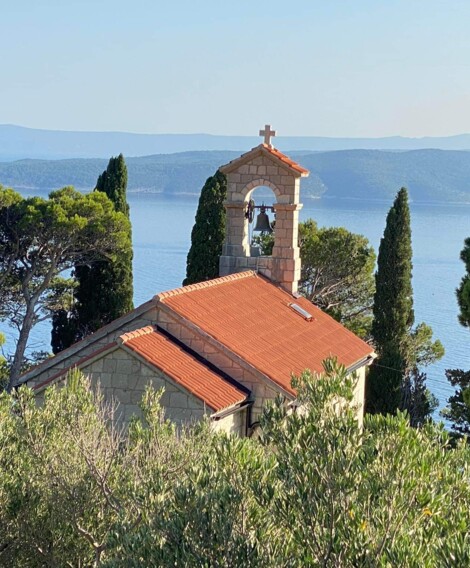
The bell tower was added later, with construction beginning in 1833. The work was led by proto-master Pavao Bertapelle and Antun Bertapelle (son of the late Pavao), his uncle Jure Andrijin Štambuk with his thirteen-year-old son Andrija (already a stonemason's apprentice), and Petar Štambuk Andrijin.
This small stonemasonry dynasty traces its roots back to the builder Andrija Bertapelle, who arrived in Dalmatia from the northern Italian city of Bassano in the 18th century. They quickly settled and assimilated in Vrboska, extending the life of Venetian Baroque in the province by skillfully blending local stone-working traditions with the art of carving polychrome marble.
Tragedy, however, marked the construction of the bell tower. After completing the first floor, the masters boarded their own gajeta (traditional wooden boat) on July 17th to return to Vrboska. They had loaded various pieces of stone, channels, and window parts at Radovnja Cove on the island of Brač. Despite the objections of others, the proto-master and the boat owner insisted on setting sail an hour before midnight, under a light land breeze (burin).
Tragically, two miles from Brač, the overloaded vessel was swamped by waves and sank instantly with its entire cargo. Jure Štambuk saved himself on a plank, while Petar Štambuk clung to the lid of a chest. They spent fifteen hours in the sea before being rescued by fishermen, the Barbarić brothers, near Dubca Cove on the island of Hvar. The unfortunate boy, Andrija Štambuk, went down with the ship. Proto-master Pavao Bertapelle was seen for a while at the stern, and Antun Bertapelle was heard for three hours after the accident, but they could not be saved.
The bell tower as a memorial to brave builders
The next time you visit the Church of Our Lady of Mount Carmel, light a candle before the icon of Our Lady in memory of the industrious Bertapelle family of builders and sculptors, and the young Andrija Štambuk. Their labor and sacrifice are built into the picturesque bell tower, whose final loggia reminds us of the bell tower of the Dominican church in Stari Grad on Hvar.